
What 30 Years as a Veterinarian Taught Me About Photographing Professionals
I photographed an attorney last week who told me, before we started, that she had never taken a headshot she liked. She’d had four sessions in her career. Four sets of photos on file that she avoided using.
About three minutes in she relaxed her jaw. I caught it on tether. She watched the frame come up on my laptop, looked at me, and said that one’s me.
I didn’t talk her into it. I didn’t trick her. I just recognized something I’d been recognizing for thirty years before I ever picked up a camera professionally.
The Background Nobody Asks About
I’ve been a practicing veterinarian for over 30 years — most of that in emergency medicine. I built Images by IBA over the last decade-plus, alongside the vet practice, and the photography is the work I’m most invested in now.
People assume the two careers don’t connect. They do, more than I expected when I started.
Emergency vet medicine is, on the human side, almost entirely about reading a face under pressure. The owner who walks in carrying a sick animal is rarely thinking clearly. They’re scared, they’re in shock, they’re trying to look composed because they think they should be. My job in those first ninety seconds was to read them — what they could absorb, what they couldn’t, when to slow down, when to be direct, when to put a hand on someone’s shoulder and let the room be quiet for a second.
I did that thousands of times. Eventually it became automatic.
Then I started photographing professionals, and I realized I was doing the same job.
What “I Hate Having My Photo Taken” Actually Means
The number-one thing clients tell me when they walk into my Wayne studio is I hate having my photo taken.
Some version of that. I’m not photogenic. I never know what to do with my face. I always look weird in photos.
After 30 years of watching humans react under stress, I can tell you what that statement actually means: I have learned to brace when a camera comes out.
Bracing is a real, observable thing. The shoulders rise a quarter-inch. The jaw locks. The smile pulls into a shape that the person thinks is a smile but reads on camera as a held expression. The eyes go just slightly past the camera instead of through it. None of it is conscious. All of it is a learned protective response — usually from one bad photo experience that the body remembered better than the mind did.
I know what bracing looks like because I watched it for three decades on people who were trying to hold it together while their dog was being intubated. The version that shows up in front of my camera is a much milder cousin of the version that shows up in the ER. But it’s the same circuit firing.
The fix is the same in both places. Slow the room down. Make eye contact. Tell them what’s happening. Let them watch.
What I Actually Do
In my studio that translates to a few specific moves.
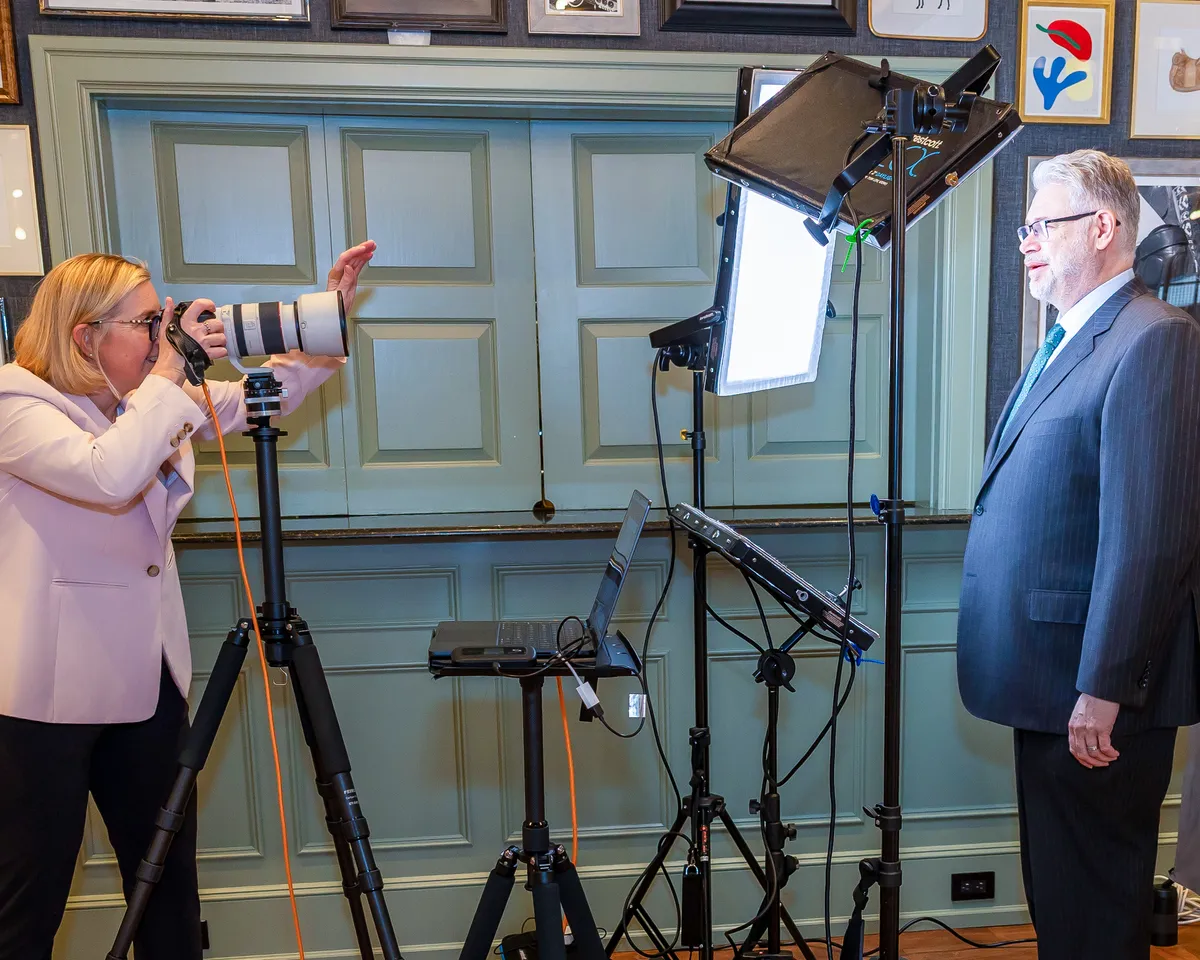
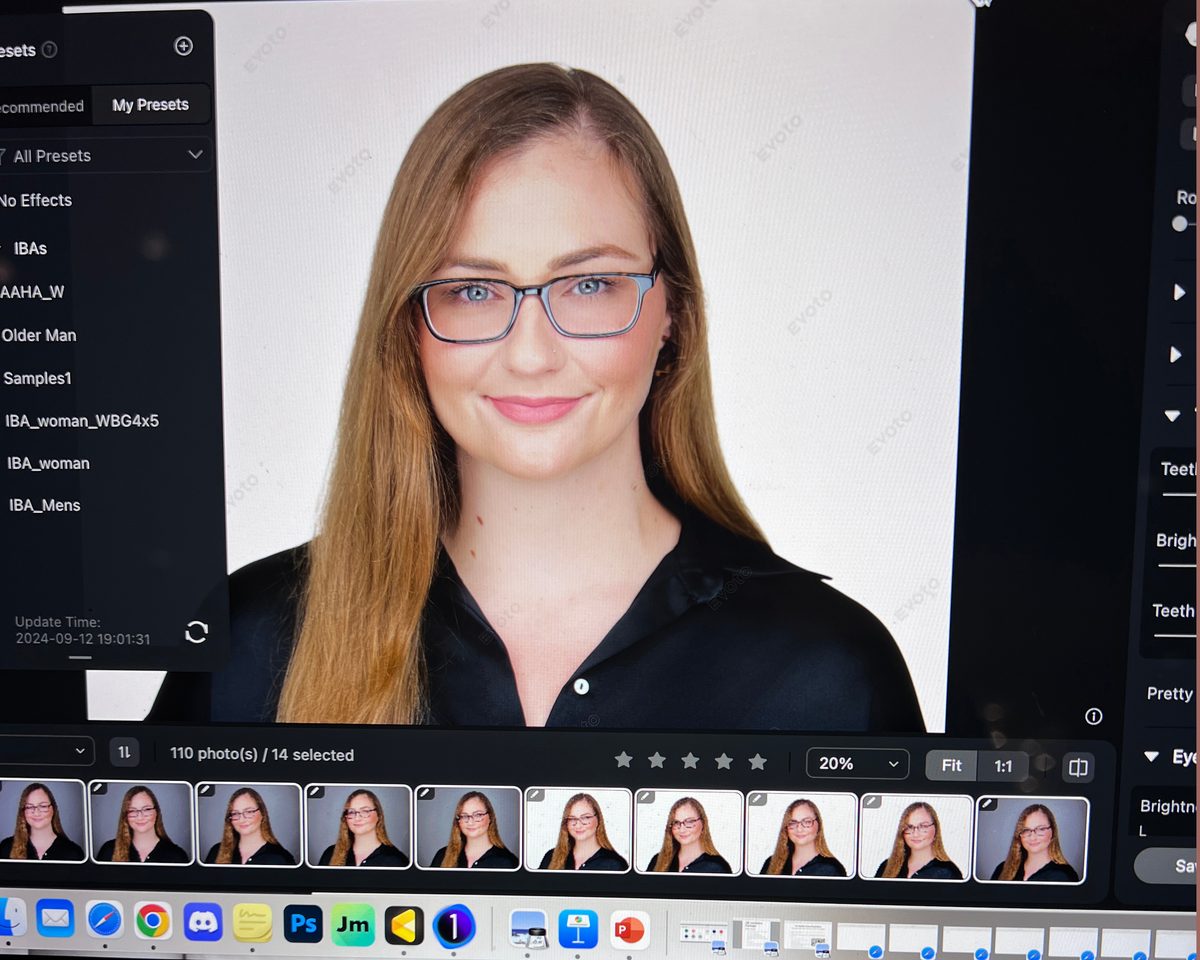
I tether every session to my laptop, which means each frame I capture comes up on a screen the client can see. They are not waiting in the dark. They watch what I’m getting, in real time, and we adjust together. The bracing eases the moment they realize they have eyes on the process.
I direct continuously. Posture, chin angle, where to put their hands, what to do with their shoulders, when to inhale before the frame. Most clients tell me they’ve never been directed in front of a camera. They’ve been told to smile or relax, both of which are useless instructions. Drop your right shoulder a quarter-inch and look at the lens like you just remembered something funny is a useful instruction. I give a hundred of those a session.
I read the face before I read the camera. This is the part that’s hardest to teach and easiest to spot in the result. I watch for the moment the held expression breaks into the real one — the moment I’d recognize across a crowded room as that’s her, that’s the actual person. I take the photo on that moment.
I let the room be quiet sometimes. Not awkwardly. Just enough that the client stops performing for me and starts existing in the frame. The best portraits come out of those pauses.
Why This Matters for Your LinkedIn Photo
A LinkedIn headshot is a small thing that does a lot of work. It opens the door to coffees, interviews, board introductions, client calls. But the photo itself is only as good as the person it captures, and capturing the person — not the held version, the real version — is the entire job.
Most photographers can light a face. Fewer can read one. The difference shows up in every single frame you’ll ever use that photo for.
After 30 years in vet medicine and a decade-plus of photographing professionals, I’m not making a marketing claim when I say I read faces well. I’m telling you what I’ve spent more than half my adult life learning to do.
The studio is twenty minutes. The result lasts two to three years across LinkedIn, your firm bio, your speaking page, your email signature, and every place your professional photo shows up.
Ready to take a LinkedIn portrait that looks like you on a good day? Book a session at my Eagle Yards studio in Wayne — five minutes from King of Prussia along the Route 202 corridor. Or view pricing for individual and team options.
Ready for Your Professional Headshot?
Book your session today and get the perfect headshot that represents you professionally.
View Pricing & Book